Annual Reports
Charter Communications, Inc.'s annual reports contain management's most considered account of the business. These are the sections, passages and visual pages worth opening in the originals preserved in Sources.
Charter Communications — FY2025 Annual Report (Form 10-K) — FY2025
The latest 10-K: converged broadband/mobile strategy, the Cox and Liberty Broadband deals, and a 4.15x-levered balance sheet. · Open the full document →
Item 1. Business — p. 7 · Read the full section →
How Charter defines itself — a fiber-powered broadband company monetizing more products per customer to lower churn and cost.
The strategy: sell more products per relationship to cut churn, acquisition and service cost.
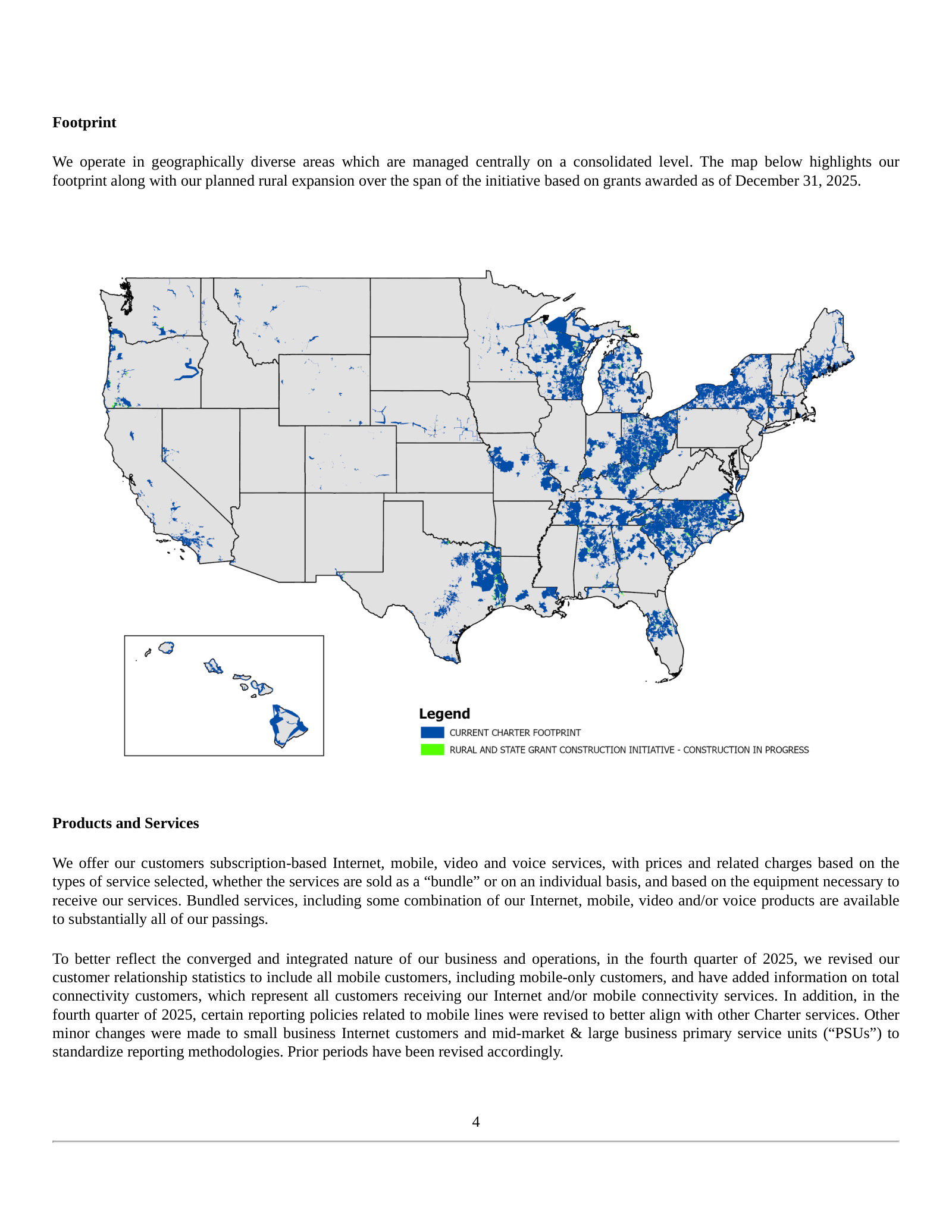
We are a leading broadband connectivity company with services available to 58 million homes and small to large businesses across 41 states through our Spectrum brand. Founded in 1993, we have evolved from providing cable TV to streaming, and from high-speed Internet to a converged broadband, WiFi and mobile experience. […] Our strategy is focused on utilizing our fiber-powered network to deliver high-quality, competitively priced products, with outstanding service, allowing us to increase both the number of customers we serve over our network and the number of products we sell to each customer. This combination also reduces the number of service transactions we perform per relationship, yielding higher customer satisfaction and lower customer churn, which results in lower costs to acquire and serve customers and drives greater profitability.
p. 7 · Read in context →
Item 1. Business — Competition — p. 27 · Read the full section →
The core bear case in management's own words: fiber overbuilders (AT&T, Verizon) and fixed-wireless attacking the broadband base.
Residential Internet competition from FTTH, fixed wireless, satellite and DSL across the footprint.
Our residential Internet service faces competition across our footprint from fiber-to-the-home ("FTTH"), fixed wireless broadband, Internet delivered via satellite and DSL services.
Several FTTH competitors deliver 1 Gbps broadband speed (and some deliver multi Gbps) in at least a portion of their footprints which overlap our footprint. AT&T Inc. ("AT&T") and Verizon are our primary FTTH competitors. We face terrestrial broadband Internet (defined by the Federal Communications Commission (“FCC”) as at least 100 Mbps) competition from AT&T and Verizon in approximately 27% and 16% of our operating footprint, respectively. DSL service is also offered across our footprint often at prices lower than our Internet services, although typically at speeds much lower than the minimum speeds we offer as part of our Spectrum pricing and packaging. In addition, commercial areas, such as retail malls, restaurants and airports, offer WiFi Internet service. Numerous local governments are also considering or actively pursuing publicly subsidized WiFi Internet access networks. In addition, providers are constructing open access networks that can deliver services from multiple underlying Internet service providers. These options offer alternatives to cable-based Internet access.
p. 27 · Read in context →
Item 1A. Risk Factors — p. 44 · Read the full section →
The two risks that could actually bite: intensifying broadband/mobile competition and a ~$95B debt load with more deal debt coming.
Competitive risk: FTTH, 5G/fixed-wireless and streaming pressuring Internet, mobile and video.
The industry in which we operate is highly competitive and has become more so in recent years. In some instances, we compete against companies with fewer regulatory burdens, better access to financing and greater and more favorable brand name recognition. Increasing consolidation in the telecommunications and content industries have provided additional benefits to certain of our competitors, either through access to financing, resources, or efficiencies of scale including the ability to launch new products and services.
Our Internet service faces competition from other companies’ FTTH, cell phone home Internet service, Internet delivered via satellite and DSL services. Various operators offer wireless Internet services delivered over networks which they continue to enhance to deliver faster speeds and also continue to expand 5G mobile services as they seek to offer converged connectivity services similar to ours. Our mobile and voice services compete with wireless and wireline phone providers, as well as other forms of communication, such as text, instant messaging, social networking services, video conferencing and email. Competition from these companies, including intensive marketing efforts with aggressive pricing, may have an adverse impact on our ability to attract and retain customers.
p. 44 · Read in context →
Leverage risk: ~$94.6B principal, 4.15x Adjusted EBITDA, plus new debt for the Cox and Liberty deals.
We have a significant amount of debt, with total principal amount of approximately $94.6 billion and a leverage ratio of 4.15 times Adjusted EBITDA as of December 31, 2025. We expect to (subject to applicable restrictions in our debt instruments) incur additional debt in the future as Charter plans to maintain leverage near the midpoint of its stated 4.0 to 4.5 times Adjusted EBITDA target leverage range (net debt divided by the last twelve months Adjusted EBITDA) in the period leading up to the Closing. As part of the Cox Transactions, Charter will fund the $4.0 billion of cash consideration using debt and will assume Cox Communications' approximately $12.6 billion of net debt and finance leases. Charter plans to adjust its long-term target leverage range after Closing to 3.5 to 3.75 times Adjusted EBITDA but will still have a significant amount of debt.
p. 52 · Read in context →
Item 7. MD&A — Overview & Results of Operations — p. 80 · Read the full section →
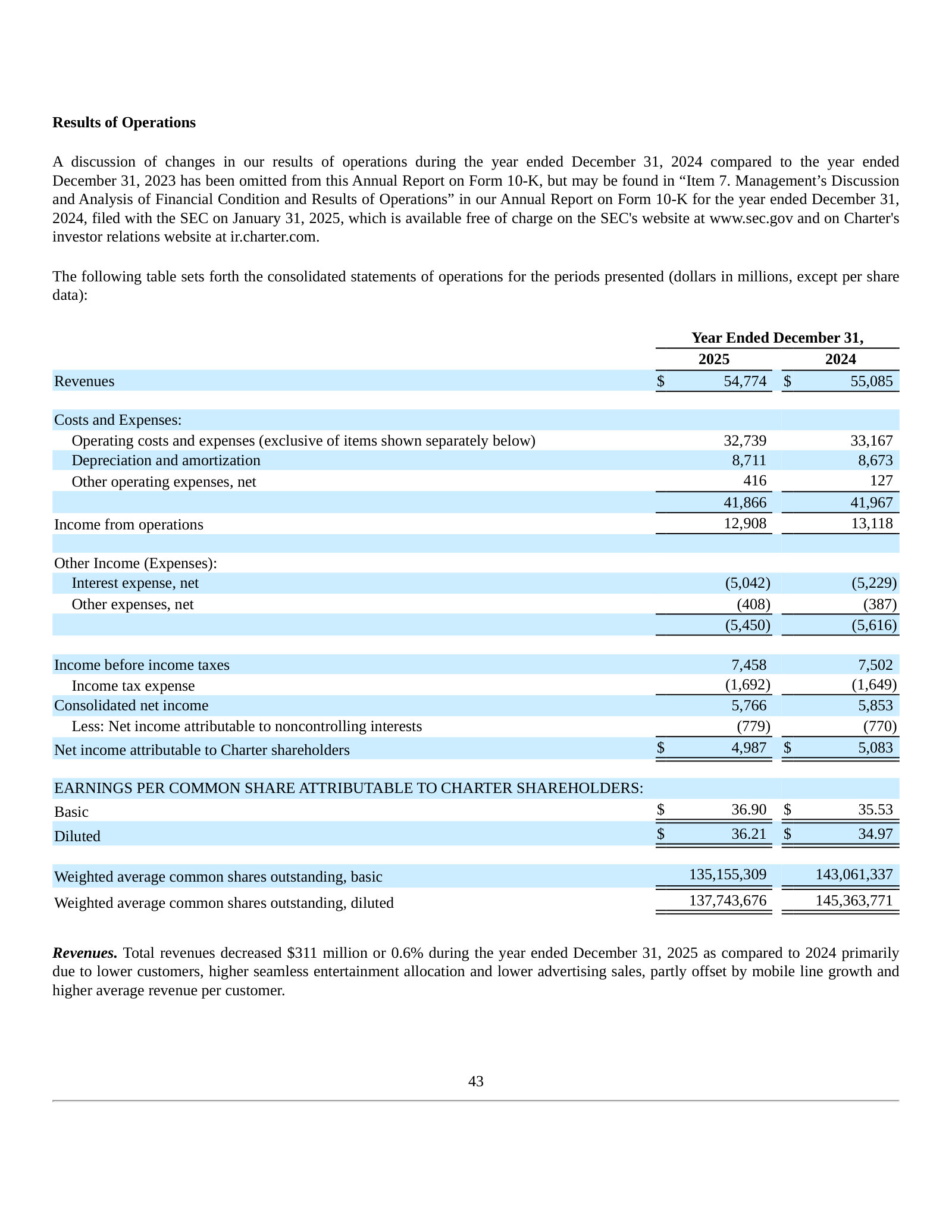
Management's account of what drove FY2025: 1.9M mobile lines added, Internet/video losses easing, sales pressured but churn lower.
FY2025 drivers: mobile line growth, improving connectivity losses, Life Unlimited pricing and programmer deals.
During the year ended December 31, 2025, we added 1.9 million mobile lines while Internet and video losses improved as compared to the prior year period. Sales were challenged by the competitive environment but were offset by lower customer churn. We remain focused on improving customer results through our brand platform, Life Unlimited which emphasizes the power of our advanced fiberpowered network and cutting-edge connectivity products and services, and our simplified pricing and packaging strategy that better utilizes our seamless connectivity and entertainment products to offer lower promotional and persistent bundled pricing to drive growth. Our Internet and mobile product bundles provide a differentiated connectivity experience by bringing together Spectrum Internet, Advanced WiFi and Unlimited Spectrum Mobile to offer consumers fast, reliable and secure online connections on their favorite devices at home and on the go in high-value packages. We have completed deals with major programmers to deliver better flexibility and greater value to our customers by including seamless entertainment applications with certain of our Spectrum TV packages at no additional cost. In July 2025, we began launching the sale of these seamless entertainment applications to customers on an à la carte basis, and we recently launched the Spectrum App Store, a digital storefront that helps customers activate, upgrade, buy and manage their streaming applications in one place. We also continue to evolve other elements of our video product and are deploying Xumo stream boxes to new video customers.
p. 80 · Read in context →
Critical Accounting Policies — Valuation and Impairment of Franchises and Goodwill — p. 84 · Read the full section →
Why the balance sheet is what it is: ~$67.5B of indefinite-lived franchise rights plus ~$29.7B goodwill — two-thirds of total assets.
Franchise intangibles ~$67.5B (44% of assets) and goodwill ~$29.7B (19%), both carried at indefinite life.
The carrying value of franchise intangibles as of both December 31, 2025 and 2024 was approximately $67.5 billion (representing 44% and 45% of total assets, respectively), and the carrying value of goodwill as of both December 31, 2025 and 2024 was approximately $29.7 billion (representing 19% and 20% of total assets, respectively).
p. 84 · Read in context →
Use of Adjusted EBITDA and Free Cash Flow — p. 94 · Read the full section →
The lens management and the board actually run the company by — the same measure that gates its debt covenants.
Adjusted EBITDA and free cash flow: how Charter measures performance and covenant compliance.
Management and the Board of Directors of Charter use Adjusted EBITDA and free cash flow to assess our performance and our ability to service our debt, fund operations and make additional investments with internally generated funds. In addition, Adjusted EBITDA generally correlates to the leverage ratio calculation under our credit facilities or outstanding notes to determine compliance with the covenants contained in the facilities and notes (all such documents have been previously filed with the SEC). For the purpose of calculating compliance with leverage covenants, we use Adjusted EBITDA, as presented, excluding certain expenses paid by our operating subsidiaries to other Charter entities. Our debt covenants refer to these expenses as management fees, which fees were in the amount of $1.4 billion and $1.5 billion for the years ended December 31, 2025 and 2024, respectively.
p. 94 · Read in context →
Note 14. Revenues — p. 168 · Read the full section →
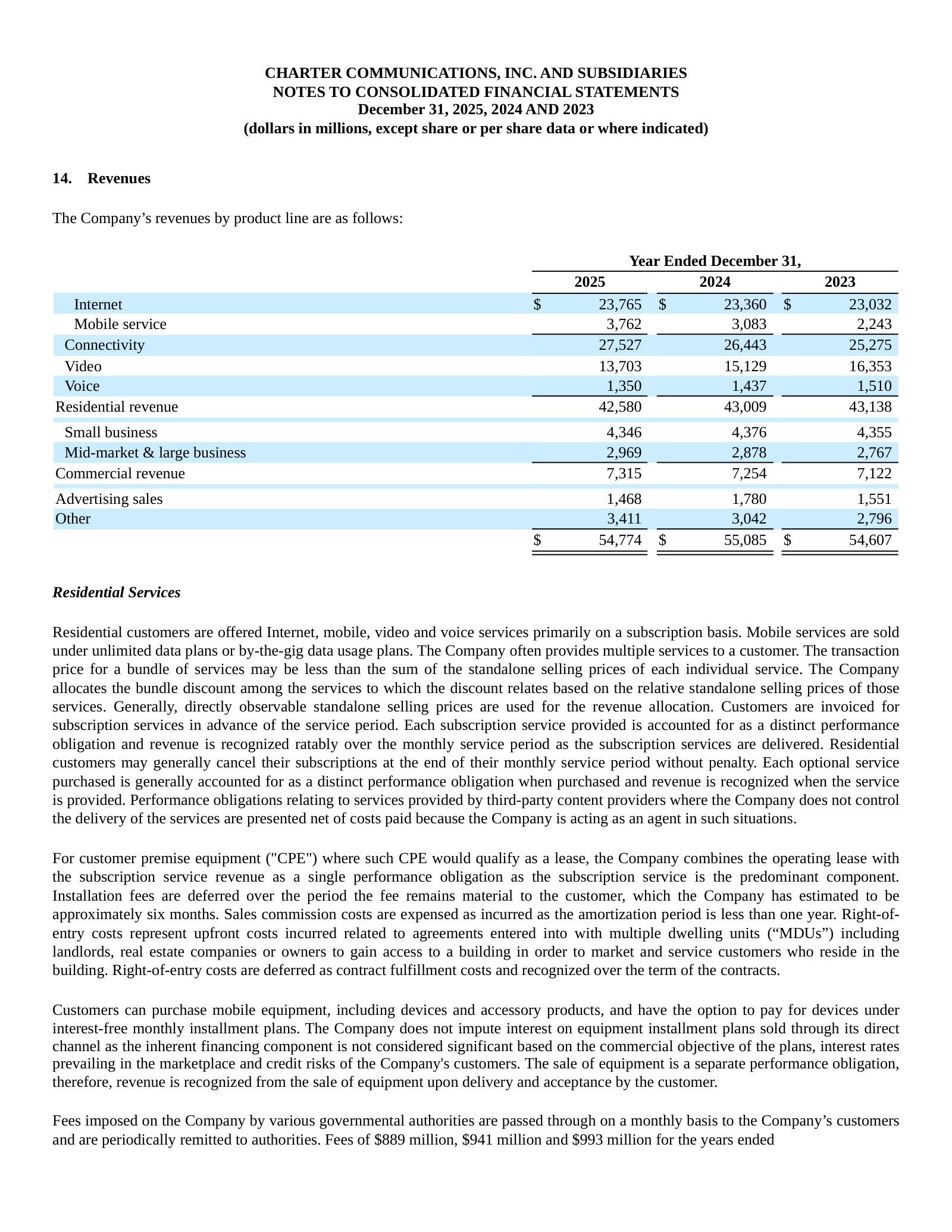
How the money actually splits: Internet and mobile now carry the mix as video and voice decline.
More annual reports
Charter Communications — FY2024 Annual Report (Form 10-K) — FY2024 · 183 pages · The prior-year baseline before the Cox and Liberty Broadband deals and the Q4 2025 customer-metric redefinition. · Open →
Charter Communications — FY2023 Annual Report (Form 10-K) — FY2023 · 174 pages · Peak of the rural construction and network-evolution capital cycle as broadband growth began to stall. · Open →
Charter Communications — FY2022 Annual Report (Form 10-K) — FY2022 · 165 pages · The year the subsidized rural build began and Spectrum Mobile scaled — the pivot toward converged connectivity. · Open →
Charter Communications — FY2021 Annual Report (Form 10-K) — FY2021 · 181 pages · Pre-pivot view: broadband still adding subscribers briskly, before competition and mobile reshaped the story. · Open →